- See my essay from last year. Unless otherwise specified, all page numbers are from that.
- Prices/wages: Firms regulate markets, not vice versa
- 'The Australian Competition and Consumer Commission (ACCC) considers the supermarket industry “highly concentrated”, with Coles and Woolworths holding two-thirds of the market between them, and their most significant (but distant) competitors being “hard discounter” ALDI, which entered the Australian market in 2001, and Metcash, a wholesale supplier to a number of
independent retailers (ACCC, 2025, p. 1). However only Coles and Woolworths have the product range to offer a “one stop shop”; having a floor area of 1,500–4,000㎡ per store stocking 15,000–25,000 SKUs versus ALDI’s average 1,000㎡ and 1,800–2,000 SKUs (ACCC, 2024a, pp. 140-141).' (p. 2) - 'The developers of price comparison app UpUp submitted to the ACCC (2024, p. 165) that the practice of weekly high-low special pricing “allows for price competition without permanently dropping prices across the board in a way that erodes long term profits”.' (p. 5)
- As Lee (2017, p. 164) puts it, “one factor relevant to shaping markets is the enterprise’s own vision of its future and the power it has to make ‘markets’ conform to it. […] markets do not coordinate economic activity or force directions on enterprises. Rather, enterprises with varying degrees of power strive to achieve their goals by shaping and governing the market.” (p. 10)
- 'The Australian Competition and Consumer Commission (ACCC) considers the supermarket industry “highly concentrated”, with Coles and Woolworths holding two-thirds of the market between them, and their most significant (but distant) competitors being “hard discounter” ALDI, which entered the Australian market in 2001, and Metcash, a wholesale supplier to a number of
- Firms do not compete on price:
- Crucially, slumps in demand do not result in lower prices, because the first firm in the market to lower prices will be matched by all others, simply resulting in decreased profit margins for all with no change in market share (Lee, 2017, p. 160). Firms will respond in other ways, such as increased promotional activity, but not a price war (Weber & Wasner, 2023, p. 189). Hence enterprises operate within a set of stability-enhancing social norms, regardless of the number of firms in, or barriers to entry to, the market (Lee, 2017, p. 162). As Lee (2017, p. 152) puts it, “market competition does not ‘manage’ enterprises, but enterprises manage competition”; competition may be pervasive, but not cut-throat. (p. 11)
- Public regulators are toothless:
- 'High, or even “excessive” pricing is not illegal, except where it involves “misleading, deceptive or unconscionable conduct” (Commonwealth of Australia, 2024b), or where there is explicit unlawful collusion; implicit price coordination is not prohibited (Fels, 2024).' (p. 2)
- The duopoly (plus ALDI) have ample scope for "Sellers' Inflation":
- 'Table 1 below summarises Coles income statements from FY20 to FY24, showing that gross profit, earnings before income and tax (EBIT), and net profit after tax (NPAT) as a percentage of revenues remained quite constant over the period, meaning that by arithmetical necessity any pandemic cost increases were more than compensated for at the checkout.' (p. 7)
- '“[…] since all firms want to protect their profit margins and know that the other firms pursue the same goal they can increase prices, relying on other firms following suit. If firms deviate from this price hike strategy, the threat of share sell-offs by financial investors can enforce compliance with such implicit agreements. Bottlenecks can create temporary monopoly power which can even render it safe to hike prices not only to protect but to increase profits.” (Weber & Wasner, 2023, p. 186). Fels (2024, p. 22) concurs, saying “Once the unrealistic assumption of perfect competition is rightfully abandoned […] the possibility of profit-led inflation is not a surprise”.' (p. 12)
- To a large degree, firms "innovate" and "compete" by shifting cost and risk onto workers, suppliers, and customers:
- 'The ACCC (2024, p. 201) found “the notion of risk- and cost-shifting to suppliers” a recurring issue in submissions, and the Senate Committee (Commonwealth of Australia, 2024b, p. 60) heard from agricultural producers that while supermarkets were redeeming reputational damage by lowering prices, the loss in revenues were being passed down to their suppliers to preserve their margins. In the other direction, supplier cost increases were said to be accepted by the supermarkets if
“accompanied by an increase in trade spend (such as rebates paid to the supermarket or additional funding for promotional activities), otherwise the proposed cost increase may only be partially accepted” (ACCC, 2024a, p. 17).' (pp. 5-6) - '"Market power can be directed against consumers, suppliers, or workers by large companies which exercise pro-active influence over prices for both inputs and outputs. Competition can be intense, but not in the manner envisioned by neoclassical perfect competition.” (Fels, 2024, p. 22)' (p. 11)
- 'The ACCC (2024, p. 201) found “the notion of risk- and cost-shifting to suppliers” a recurring issue in submissions, and the Senate Committee (Commonwealth of Australia, 2024b, p. 60) heard from agricultural producers that while supermarkets were redeeming reputational damage by lowering prices, the loss in revenues were being passed down to their suppliers to preserve their margins. In the other direction, supplier cost increases were said to be accepted by the supermarkets if
- This is particularly acute in the case of agricultural suppliers (as we covered on Local Food Connections):
- 'Trade association AUSVEG submitted to the ACCC (2024, p. 31) that “78% of retail fresh vegetables are sold through ALDI, Coles and Woolworths”.' (p. 6)
- 'The National Farmers Federation said that “there are almost no pre-existing contracts in place. All price and volume is determined literally in the last week before it goes to sale. […] The growers bear all of the risk in this process” (Commonwealth of Australia, 2024b, p. 51). Craig Emerson testified to the Senate Committee (Commonwealth of Australia, 2024b, pp. 63-64) that : “I think it's an unsatisfactory situation where many are on such tight margins that they're not necessarily closing tomorrow, they've got enough just to survive, but definitely not enough to invest in those sorts of technologies to improve quality and reduce price”.' (p. 6)
- Cost-shifting to employees:
- 'The Senate Committee heard from Coles that 40% of its workforce earned less than $500 per week. The upstart Retail and Fast Food Workers Union (RAFFWU) noted that although the duopoly pay above minimum wage, the difference is “a matter of cents” (Commonwealth of Australia, 2024b, p. 76) , and that in addition to struggling to afford the groceries that they sell, in the minds of customers workers serve as the public face of the company. Coles received around 8000 reports of worker abuse between June 2013 and March 2024 — likely an undercount, according to RAFFWU (Commonwealth of Australia, 2024b, p. 78). The Shop, Distributive & Allied Employees' Association (SDA) emphasised “use of technology and automation to extract cost savings from consumers and employees” (Commonwealth of Australia, 2024b, p. 79). In addition to recently introduced “skip scan”, “bottom of trolley”, and “smart gate” theft prevention measures, the Sydney Morning Herald reports (Yun, 2024) that Coles is requiring that customer service (not security) staff “assist” customers at self-checkouts with scanning bulky items. Coles told the Herald that “This is all about providing great service to our customers and helping them get through the checkouts quickly and efficiently,” however RAFFWU countered “This is about stock loss. That just increases the chances of confrontation and conflict, and that’s what we don’t like.”' (p. 9)
- Supermarkets are gig economy pioneers:
- 'The crucial point that such critiques miss is that the extractive trajectory has not been “smuggled in” from big tech and the gig economy but, in the Australian context at least, algorithmic management began with the grocery sector. As O’Neill et al. (2025) relate, in the late 1980s and early 1990s, the five (as opposed to today’s four) grocery firms with substantial logistics infrastructure together engaged a small phalanx of American consultancies to rationalise their warehouse operations under the rubric of Engineered Standards. This introduction of “neo-Taylorism” and levers of algorithmic management such as key performance indicators (KPIs) to the Australian workplace is by now so well-established that as Kelly (2024) argues, far from displacing dominant grocery firms, app-based gig work is being subsumed into them due to the supermarkets decades of first-mover advantage.' (p. 10)
- While workers at Coles’ new CFCs (and Woolworths’ smaller “dark stores”), are considered retail workers covered by the SDA, workers at other warehouses represented by the United Workers Union enjoy substantially higher rates of pay. Kelly (2024, p. 1244) argues that rather than stifling competition, “the supermarket duopoly strengthens cooperation among supermarkets and large employers, the gig economy and partner unions, while intensifying competition between groups of workers.” (p. 14)
- Maintaining and enhancing market power is the primary goal. Market power is a key determinant of the cost of finance. Cheaper finance in turn feeds back into greater capacity to gain and exercise market power.
- 'Price leadership is another important factor in market governance. A large firm will generally enjoy a cost advantage over smaller rivals, as well as access to finance under more favourable terms. The dominant firm(s) in a market will therefore be able to set prices at a level that smaller firms cannot match without accepting a lower profit margin. So dominant firm(s) will have greater capacity to invest and expand, and be better positioned to weather cyclical downturns and other shocks without reducing margins or investment (Lee, 2017). Therefore the natural tendency of markets under current conditions is toward concentration.' (pp. 12-13)
- 'In this context, it is interesting to consider the case of ALDI. As a privately-held firm it is less exposed than its Australian competitors to investor retaliation for achieving growth at the expense of profit. However, after 20 years of bricks-and-mortar expansion as the sole “hard discounter” in the market, it testified to the ACCC (2025), that it has no significant plans for further expanding its store network, nor to compete against Coles and Woolworths in the online market. The ACCC (2025, p. 375) notes that between FY20 and FY24, ALDI’s average product margin increase (1.9%) was nearly equal that of Woolworths (2%) and greater than that of Coles (1.5%). In nominal terms, ALDI’s product margin increase was considerably higher than either (49% versus 29% and 25%), perhaps suggesting that capitalising on the existing material footprint and following the price leaders is seen as a wiser strategy than continuing expansion and challenging them to a price war at scale.' (p.13)
- What we see in the supermarket sector is a predictable (and, one assumes, deliberate) outcome of public policy informed by economic mythology.
- 'As a rule, Australia’s mode of regulation “governs, guides, supports and secures the process of accumulation” (Chester 2010, p. 314). The Senate Committee’s report is of interest as an outlier in this respect. It was alone in considering the interests of supermarket workers (Commonwealth of Australia, 2024b, pp. 93-98), it recommended amending consumer law to create divestiture powers to counter misuse of market power or “unconscionable conduct” (Commonwealth of Australia, 2024b, p. vii) — the Emerson report was the only other to consider divestiture, and strongly opposed it (Commonwealth of Australia, 2024a, pp. 88-89) — and it recommended a further amendment to prohibit the charging of excess prices (Commonwealth of
Australia, 2024b, p. vii).' (p. 15) - 'The ACCC performs a valuable role for business here by maintaining that “retail prices and margins are not susceptible to confident assessments of whether they are ‘excessive’” (ACCC, 2025, p. 397). That is, only perfectly competitive markets are truly capable of arriving at correct prices, so the most one can say with confidence is “If there were a greater degree of competition between supermarkets, we would expect margins to be lower, either by way of lower retail prices, or higher costs incurred to improve quality of service, or both” (ACCC, 2025, p. 398). Moreover “a credible threat of new entry alone may prevent any attempt to exercise market power in the first place” (ACCC, 2024a, p. 174). They do of course recognise that no such credible threat exists, as ALDI has taken 20 years to capture 10% of the market (ACCC, 2024a, p. 175) and has no reasonable prospect, or indeed intention, of directly competing with the duopoly at the same scale and scope of operation (ACCC, 2024a, p. 279). Yet the ACCC insists that the best that regulation can do is increase market transparency and reduce barriers to entry until perfect competition arrives. The ACCC is to all intents and purposes a competition cargo cult. It is hardly surprising that with the release of the ACCCs recommendations, supermarket share prices “surged” (Chalmers et al., 2025) at the news that market stability had been preserved.' (pp. 15-16)
- In the absence of countervailing forces which existed in the pre-neoliberal era, historically high profit margins are a cause, not a consequence, of market concentration.
- 'As a rule, Australia’s mode of regulation “governs, guides, supports and secures the process of accumulation” (Chester 2010, p. 314). The Senate Committee’s report is of interest as an outlier in this respect. It was alone in considering the interests of supermarket workers (Commonwealth of Australia, 2024b, pp. 93-98), it recommended amending consumer law to create divestiture powers to counter misuse of market power or “unconscionable conduct” (Commonwealth of Australia, 2024b, p. vii) — the Emerson report was the only other to consider divestiture, and strongly opposed it (Commonwealth of Australia, 2024a, pp. 88-89) — and it recommended a further amendment to prohibit the charging of excess prices (Commonwealth of
- And recently:
- Coles found to have misled shoppers on discounted items in bombshell Federal Court case
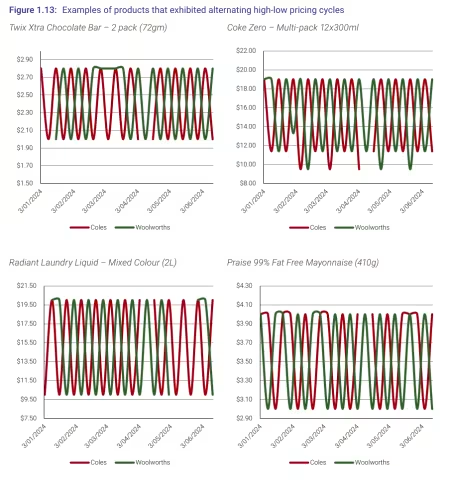
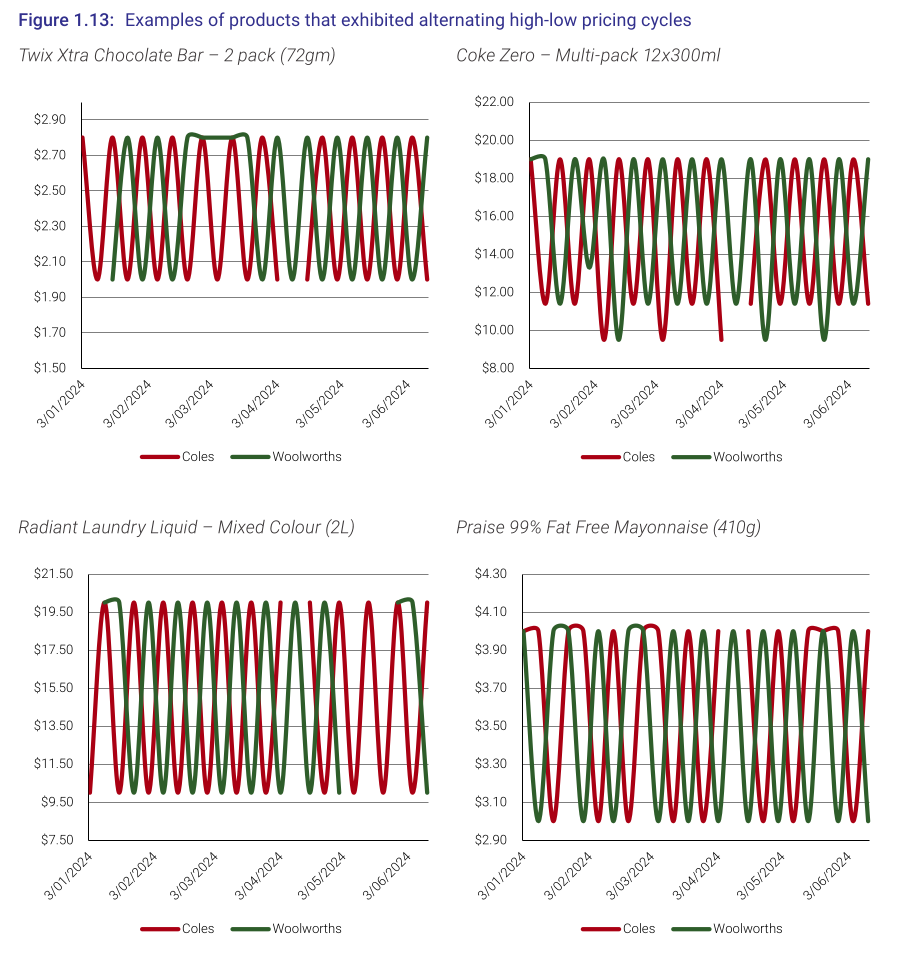
- … But although it has addressed misleading advertising practices, it still doesn't (and deliberately so, because the ACCC can't) tackle prices, or "high-low pricing" like this:
- Two main types of
state-run food stores are identified: managed margin stores and fair price shopsTwo main types of
state-run food stores are identified: managed margin stores and fair price shopsThe Problems - Image
The Solutions
- Nationalisation
- “The power of a few to manage the economic life of the nation must be diffused among the many or be transferred to the public and its democratically responsible government. If prices are to be managed and administered, if the nation's business is to be allotted by plan and not by competition, that power should not be vested in any private group or cartel, however benevolent its professions profess to be.” (Roosevelt, 1938).
- "Countervailing power"
- Agricultural co-operatives, an organisational form which peaked in the 1950s and declined sharply in the last decades of the century, allowed farmers to collectively pool risk, bulk purchase supplies, and eliminate intermediaries by marketing and distributing their own goods. However, as Patmore et al. (2021, p. 1) put it, with the rise of neoliberalism, “An emphasis was placed on economic performance over the benefits that arise from consumers, farmers, and others having direct control over their economic fortunes.” In 1995 Allan Fels, as chair of the ACCC, criticised co-operatives as anti-competitive. In addition, governments terminated agricultural income stabilisation schemes, deregulated and eventually privatised state based bulk handlers and single desk marketing boards, and abolished minimum price regulations and production quotas. (Patmore et al., 2021, p. 11). (p. 14)
- "Steps to strengthen countervailing power are not, in principle, different from steps to strengthen competition. Given the existence of private market power in the economy, the growth of countervailing power strengthens the capacity of the economy for autonomous self-regulation and thereby lessens the amount of over-all government control or planning that is required or sought." John Kenneth Galbraith, 1952
- Public supermarkets
- See my awful video essay from last year. (I tried extemporising rather than reading from a script, which I just can't do without an audience. A friend phoned me while I was failing at this and advised "Just have a glass of wine." "I've had three! It's no better, and now I'm slurring my words!" I have since hit upon using my teddy bear as an audience.)
- Mamdani/NYC
- Mayor Mamdani Announces La Marqueta as First Site Identified for City’s Public Grocery Stores
- What We Know About Mamdani’s First Planned City-Owned Grocery Stores
- Mayor Mamdani Announces the Peninsula in the Bronx as the Second Site for City’s Public Grocery Stores
- Proposed local legislation to make permanent no fewer than 5 stores in each of NY's 5 boroughs, open at least 12hrs/5days/week, paying union wages.
- "Competitive neutrality"
- "Competitive neutrality requires that government business activities should not enjoy net competitive advantages over their private sector competitors simply by virtue of public sector ownership.
The implementation of competitive neutrality policy arrangements is intended to remove resource allocation distortions arising out of public ownership of significant business activities and to improve competitive processes. Where competitive neutrality
arrangements are not in place, resource allocation distortions occur because prices charged by significant government businesses need not fully reflect resource costs. Consequently, this can distort decisions on production and consumption, for example where to purchase goods and services, and the mix of goods and services provided by the government sector. It can also distort investment and other decisions of private sector competitors.
Competitive neutrality requires that governments should not use their legislative or fiscal powers to advantage their own businesses over the private sector. If governments do advantage their businesses in this way, it will distort the competitive process and reduce efficiency, the more so if the government businesses are technically less efficient than their private sector competitors. Private competitors also regard such advantages as simply inequitable, as is illustrated by the number of complaints about this issue made to the Independent Committee of Inquiry into National Competition Policy1. This inequity is particularly marked where government businesses are not subject to tax and private businesses see their own tax payments as effectively subsidising their government business competitors. - Australian Government Competitive Neutrality Complaints Office (AGCNCO), a unit in the PC
- "Competitive neutrality requires that government business activities should not enjoy net competitive advantages over their private sector competitors simply by virtue of public sector ownership.
- State-Run Food Retail Chains as a Tool of Food Security: An Analysis of Existing Practices: "Two main types of state-run food stores are identified: managed margin stores and fair price shops."
An MMT model of grocery provision
- Countervailing power
- Not competitively neutral, intended to discipline the private sector and bring down margins.
- Public provision that set benchmark price(s)/margins.
- Not welfarism that preserves or exacerbates high private sector margins.
- Economic stabilisation / ecological resilience
- Sets prices at a percentage of the JG wage, maintains the JG as the macro price level instrument
- Increases resilience via nation-wide wholesale network:
- Freight, logistics, buffer stocks of less-perishable goods
- Private retail can piggy-back on this
- Extends scope, quality of service, especially to regional/remote areas and metropolitan food deserts.provision